How to walk Gamcheon beyond the photo spots: a respectful hillside guide
Your trip at a glance
- Start
- Toseong Station
- Time needed
- 3–5 hours
Toseong Station Exit 6 → Visitor information → Upper interpretation route
Contents +
A three-to-five-hour guide covering the Toseong bus transfer, refugee settlement geography, regeneration, privacy, and realistic slope choices.

QUICK ANSWER
The short answer
From Toseong Station Exit 6, transfer to a village bus shown by current signage and get off near Gamjeong Elementary School, then walk about five minutes. Spend three to five hours using the information center and public routes to understand refugee settlement, terraced housing, hillside labor, and cultural regeneration. This remains a residential neighborhood: avoid drones, voices that carry, filming inside gates or windows, and poses that block stairs.
- Start
- Toseong Station Exit 6
- Required
- Village-bus transfer
- Recommended time
- 3–5 hours
- Difficulty
- High · slopes and stairs
- Core rule
- Residential privacy first
- Check
- Seasonal visitor-facility hours
TAKE IT WITH YOU
Turn this guide into a route you can use
Open the stops in Google Maps and keep the Korean place names ready for signs, ticket desks, and local searches.
- Start
- Toseong Station Exit 6
- Time needed
- 3–5 hours
- Required
- Village-bus transfer
START & TRANSPORT
Your first leg and official transport information
Suggested exit & walk
Toseong Station Exit 6Check the first leg and transport in the route below.The suggested exit may not be the lift exit. With luggage or mobility needs, prioritise the accessible route.Select the station to check direction-specific timetables, lifts and luggage lockers together.
- 01Toseong Station Exit 6
- 02Visitor information
- 03Upper interpretation route
- 04One community space
- 05Short lane or rest
Last check before you go
Check closures, bookings and weather. With large bags, arrange storage and a collection time before setting out.
Recheck last trains, transfers, works and lift availability.
Check the origin, interchange and destination separately. Maintenance can change the route, so ask station staff for day-of help.
Times vary by line, direction, weekday, weekend and holiday. For a late trip, verify the last possible interchange too.
The map links named places only. Add your chosen restaurant, performance or rest stop separately. Recheck last trains, works and facility outages with the official operator.
CHAPTER 01
Question one: who calls this place home?
Gamcheon is a lived hillside neighborhood before it is an open-air gallery.
Colorful roofs can make the village look like a set, but meals, deliveries, rest, and school journeys continue behind the gates. A responsible visit is measured less by the number of photo spots than by how little it disrupts daily life.
Do not point a camera through open doors or windows, identify residents or vehicle numbers, or organize a photo queue on narrow stairs. Publicly visible does not automatically mean ethically publishable.

CHAPTER 02
Question two: have you planned the transfer and the return?
Toseong is the transit starting point, not the village entrance.
Visit Busan directs travelers from Exit 6 to village buses such as Saha 1-1 or Seo-gu 2 routes, then about five minutes from Gamjeong Elementary School. Numbers and service can change, so use current stop information.
Save the Korean return-stop name as soon as you arrive. Large suitcases do not belong on a small hillside bus, and a taxi cannot be assumed to reach every narrow upper lane.

CHAPTER 03
Question three: why do the homes follow the slope?
War displacement, limited flat land, and daily travel to work shaped the stepped settlement.
Official interpretation traces the community to postwar refugee settlement from the 1950s. Houses followed the mountain without entirely blocking those behind, while interconnected alleys helped organize life on scarce land.
Do not reduce this history to picturesque poverty. Connect the view with port and market labor, repeated climbs, and the long process of improving housing. Beauty and difficult living conditions can be acknowledged together.

CHAPTER 04
Question four: what did cultural regeneration preserve and alter?
Art and workshops brought visitors while increasing pressure on residential space.
Public art, community programs, and reused buildings improved visibility and some facilities. They also concentrated queues and commercial attention in narrow lanes. Observe both outcomes rather than declaring regeneration either pure success or failure.
Support locally operated workshops transparently when they fit your interests, but do not use a tiny shop as a long photo studio without purchasing or asking.


CHAPTER 05
Question five: how much Gamcheon fits your body today?
A shorter public loop can be better than forcing every stair.
Gradients are steep and stair height varies. Heat removes shade; rain and ice create slip risk. Ask for a short upper loop and return the same way when necessary.
Accessible toilets or parking do not make all alleys wheelchair-friendly. Ask the information center about the current wider route and keep checking fatigue.

CHAPTER 06
Final question: what remains after you leave?
Rubbish, noise, geotags, and uploaded images can outlast the visit.
Carry packaging to a proper bin and leave before visitor facilities close rather than treating evening as permission to enter quieter residential lanes.
Before posting, check faces, interiors, addresses, and vehicle numbers. Repeated geotagged images can send future visitors to the same private gate.

REALISTIC ITINERARY
Walk with five questions, not a photo-spot count
Use the upper public route and shorten it whenever heat, slope, or crowds require.
- 00:00Toseong Station Exit 6
Confirm the live village-bus route and return stop.
- 00:35Visitor information
Check hours, map, and public route.
- 01:00Upper interpretation route
Read refugee settlement and terraced geography.
- 02:10One community space
Observe how regeneration meets everyday life.
- 03:00Short lane or rest
Replace stairs with a wider route if needed.
- 04:00Official bus stop
Leave residential lanes before evening quiet.
FOR INTERNATIONAL TRAVELERS
Prepare for both slope and privacy
- Travel with a small bag; solve luggage before the village bus.
- Save bus stops and return directions in Korean.
- Avoid drones, telephoto intrusion, and tripods at private gates.
- Shorten the route in heat, rain, or ice.
- Use 1330 for interpretation and 112 or 119 in emergencies.
FAQ
Gamcheon transport, hours, and resident etiquette
Can I walk from Toseong Station to Gamcheon?
The steep climb is the problem. The official village-bus transfer is more realistic.
Which village bus should I take?
Official information lists routes including Saha 1-1 and Seo-gu 2 services; confirm current signage and live information.
Is Gamcheon free?
Public lanes are free, while maps, activities, and selected facilities may charge.
What are the visitor hours?
Official visitor facilities are generally listed as 09:00–18:00 from March to October and 09:00–17:00 from November to February. Homes are not tourist facilities.
May I fly a drone or photograph residents?
Official etiquette asks visitors to avoid drones and privacy-invasive photography.
Check official information (3)
Information checked 2026.09.02
Hours, prices and closures can change. Check the official notice before visiting.
A research-based guide, not a first-hand trip report.
CONTINUE EXPLORING
Continue at the next station
Three next trips selected by comparing city, travel themes, and available time—without simply repeating the same neighborhood.

What lies across Busan Station? Choryang Ibagu-gil as an elevation story
A three-to-five-hour route from the railway gateway through migration history and the 168 Stairs, with realistic luggage and alternative-route choices.

The best way to explore Bukchon is slowly and quietly
A practical, resident-first route from Anguk Station covering public hanok, neighborhood etiquette, red-zone hours, accessibility, and a realistic three-hour itinerary.
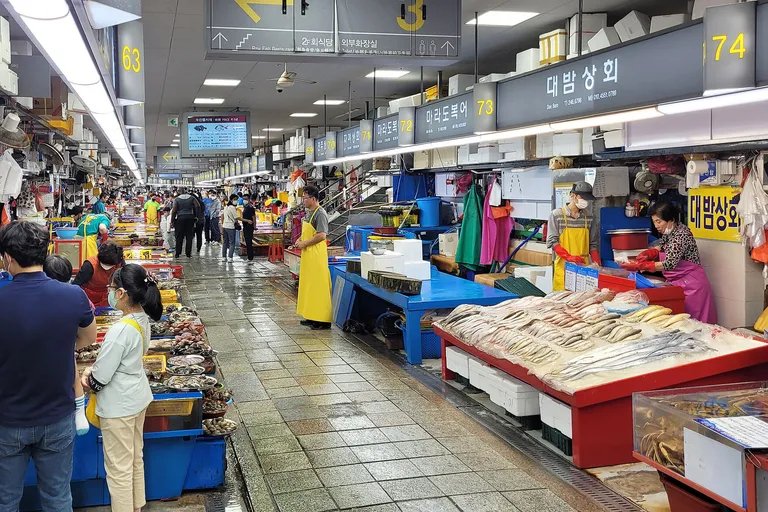
Jagalchi: seafood trade and refugee-era books
Learn the market’s pricing and cooking system, then walk to Bosu Book Street to trace two forms of port-city livelihood.